If you own or manage a commercial property in Greenville, Anderson or anywhere in the Upstate, there is a good chance your water service has a backflow prevention assembly on it — and a good chance your water provider expects it tested on a schedule. It is one of those requirements that stays invisible until a notice arrives. Here is what the device does, why it is required, and what testing involves.
What Backflow Is
Water in a public system is supposed to travel one direction: from the main into your building. Backflow is when that reverses and water from inside the property is drawn back into the public supply.
It happens for two reasons. Back-siphonage occurs when supply pressure drops suddenly — a water main break, or heavy draw during firefighting — creating suction that pulls water backward. Back-pressure occurs when a system inside the building produces higher pressure than the supply, such as a boiler or a pressurized process line, and pushes its water into the main.
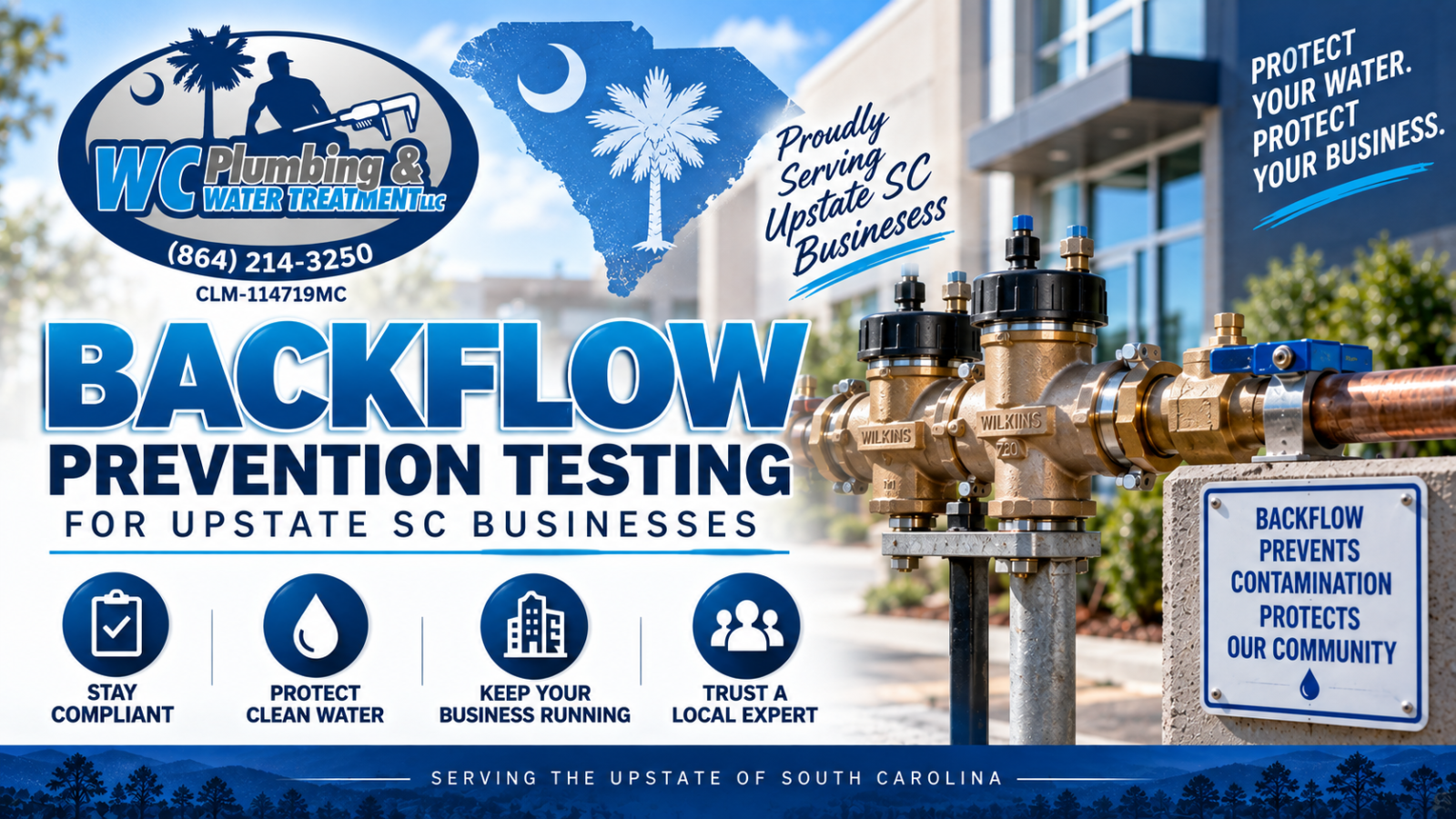
The concern is what that reversed water carries. Irrigation lines sit in soil with fertilizer and pesticide. Boiler loops contain treatment chemicals. Commercial kitchens, salons, medical offices, car washes and manufacturers all have connections that must never reach drinking water. A backflow preventer is the mechanical barrier that keeps them apart.
Why Testing Is Required
A backflow assembly relies on check valves and relief components with springs, seats and rubber that wear. The device can fail while giving no outward sign — water still flows normally to the building, so nothing looks wrong. Only a test reveals that the protection is gone.
That is why water providers require periodic testing by a certified tester, commonly once a year, with results submitted to the utility. Requirements and deadlines vary by provider, so confirm the specifics with the utility serving your property. A missed test can mean escalating notices and, in some cases, interruption of service — an avoidable problem for any business.
Which Properties Usually Have One
- Restaurants and commercial kitchens
- Buildings with irrigation systems — including many offices and retail centers
- Properties with fire suppression systems
- Medical, dental and veterinary offices
- Salons, laundromats and car washes
- Manufacturing and processing facilities
- Apartment and multi-family buildings
Some residential properties need one too, most often where there is an irrigation system, a pool, or a well on the same property as a city connection.
What a Test Involves
A certified tester attaches a gauge to the assembly’s test ports and verifies that each check valve holds and that the relief valve opens at the correct pressure. Water is off briefly — usually a matter of minutes — so it is worth scheduling around your business hours rather than mid-shift.
If the assembly passes, the report goes to your water provider and you are set for the cycle. If it fails, it needs repair or replacement and a retest. Many failures are rebuildable with a repair kit rather than a full replacement, which is a meaningful cost difference.
Keep the Paperwork
Hold onto your test reports. They establish compliance history, they matter during a property sale or lease negotiation, and they save time when a new manager inherits the building and no one can say when the device was last checked.
Commercial Plumbing Across the Upstate
WC Plumbing & Water Treatment handles backflow prevention devices along with the rest of commercial plumbing — drain cleaning, lift stations, commercial water heaters and leak repair — for businesses in Greenville, Anderson, Clemson, Easley and across the Upstate. South Carolina License CLM-114719MC. Call (864) 214-3250 or schedule your test.