When a water heater finally gives out, most homeowners are making the replacement decision under pressure — cold showers, a wet floor, and a need to fix it today. That is the worst time to weigh tankless against a conventional tank. If yours is getting old, here is the comparison worth having now, while you still have a choice.
How They Differ
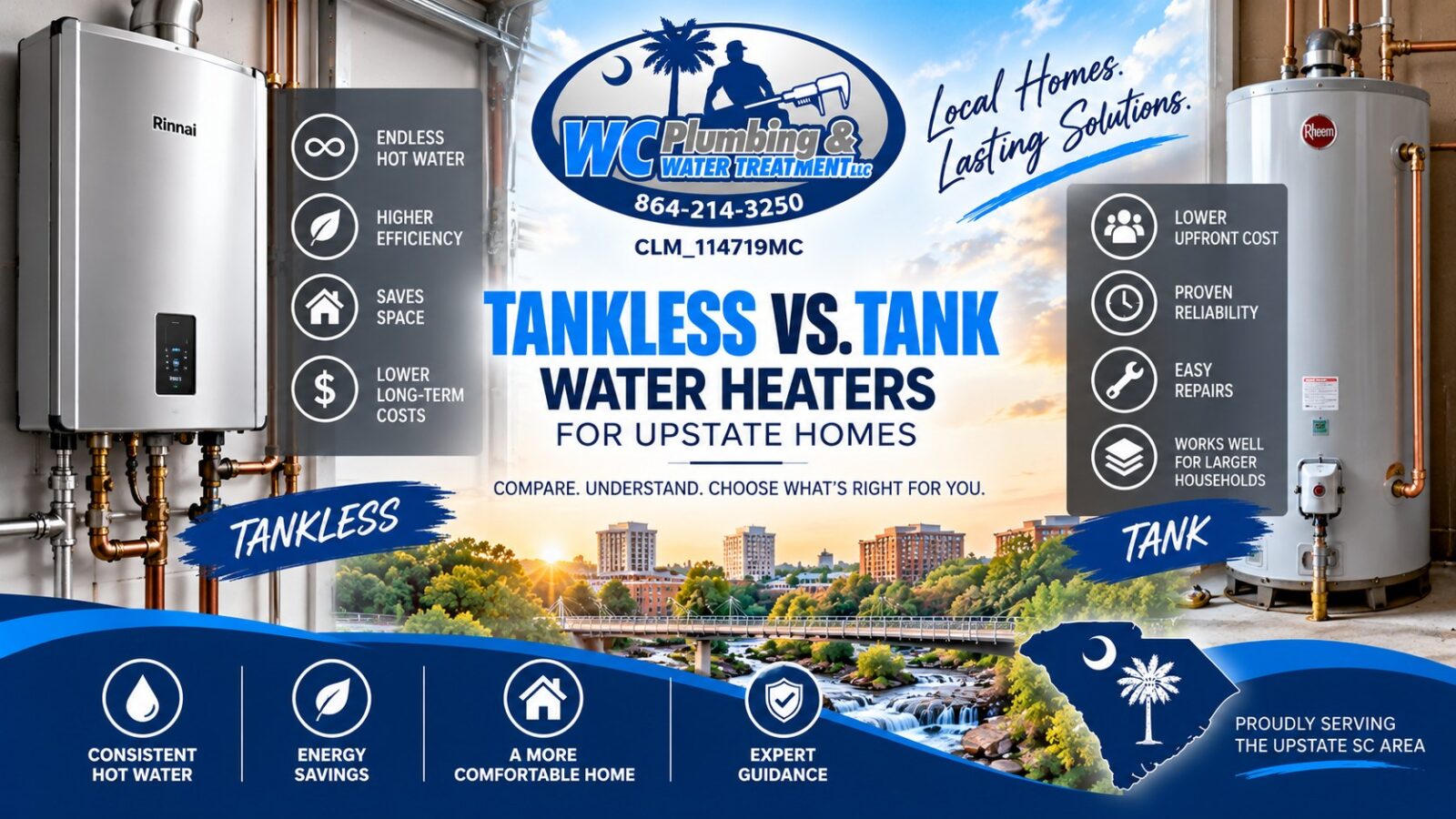
A conventional tank heater keeps 40 to 80 gallons hot around the clock so it is ready when you are. A tankless unit heats water only as it flows, firing up when you open a hot tap and shutting off when you close it. That single difference drives everything else.
Where Tankless Wins
- Hot water does not run out. Back-to-back showers, or a shower while the dishwasher runs, without anyone drawing the short straw.
- Lower standby loss. A tank reheats its stored water all day whether you use it or not. Tankless does not, which generally means lower operating cost.
- Longer service life. Well-maintained tankless units commonly outlast tank heaters by a wide margin.
- Space back. A wall-mounted unit frees up a closet or a corner of the garage.
- No stored gallons to dump. A tank failure puts its entire contents on your floor. Tankless removes that risk.
Where a Tank Still Makes Sense
- Lower upfront cost. Both the unit and the installation are usually cheaper, which matters when the old one just failed.
- Simpler swap. Replacing tank with tank often needs no changes to gas line, venting or electrical. Converting to tankless sometimes does, and that work is part of the real price.
- High simultaneous demand. Tankless delivers a flow rate, not a reservoir. A large household running several fixtures at once needs a properly sized unit — or two — to keep up.
- Cold incoming water. A tankless unit has to raise incoming water to your set temperature in one pass. In an Upstate winter, incoming water is much colder than in July, so a unit sized for summer can disappoint in January. Sizing has to be done for the cold months.
The Factor That Decides It for Many Upstate Homes: Your Water
Hard water is hard on both types, but it punishes them differently. In a tank, scale settles to the bottom and insulates the burner or elements — the rumbling and slow recovery described in Five Signs Your Water Heater Is About to Fail. In a tankless unit, scale builds in the narrow heat exchanger, where it restricts flow and can trigger fault codes.
This matters most for homes on private wells, where hardness and iron are common across Anderson, Pickens and Oconee counties. Tankless units in hard water need periodic descaling, and skipping that maintenance is the fastest way to lose the long lifespan you paid for. Installing a water softener alongside the heater protects it and everything else in the house — genuinely the highest-return pairing we install.
Sizing Beats Brand
Whichever you choose, sizing is what determines whether you are happy with it. That means counting bathrooms and fixtures, thinking about how your household actually uses hot water, and — for tankless — designing around winter inlet temperatures. A unit chosen by matching the label on the old one is a coin flip.
Water Heater Installation in the Upstate
WC Plumbing & Water Treatment installs, repairs and replaces both tank and tankless water heaters for homes in Greenville, Anderson, Clemson, Seneca and across the Upstate — and we can address the water chemistry that shortened the last one’s life at the same time. South Carolina License CLM-114719MC. Call (864) 214-3250 or request an estimate.